The fight to keep ‘fabric first’ under the Future Homes Standard
Industry insights from James Parker, Managing Editor, Housebuilder & Developer

The publication of the Future Homes Standard has brought much-needed clarity for the housebuilding industry, but it has also reignited debate around one of its core principles: fabric first.
At a recent industry round table, leading housebuilders, consultants and construction supply chain partners explored whether the balance has shifted too far towards low-carbon technologies at the expense of building fabric and why getting the details right will be critical to delivering homes that perform as intended.
With the arrival of the Future Homes Standard recently has come some welcome clarity for the housebuilding sector following months of speculation. But, as was revealed by a recent ‘Building Insights LIVE’ round table held on the subject, the publication of the final ‘consultation response’ has also thrown up challenges and questions.
‘Fabric first’ was the initial maxim behind the Standard when it was first mooted, and ostensibly remains so in the published version, particularly within the Fabric Energy Efficiency Standard (FEES), which is embedded in the overall regulation.
As agreed by the housebuilders, consultants, academics, and construction supply chain representatives we convened in London, prioritising homes’ fabric performance in new builds is highly challenging. This is especially true given the overwhelming focus on heat pumps and photovoltaic (PV) systems.
The round table staged by netMAGmedia offered a strong case for why the sector needed to prioritise fabric, and how housebuilders can work closely with suppliers on the details, to ensure that thermal performance is optimised.
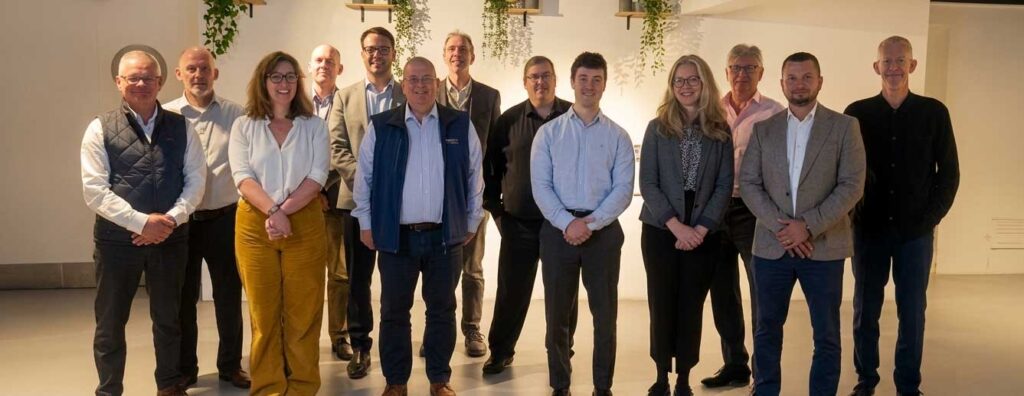
The event, titled “Keeping Fabric First in Future Homes Standard Compliance” was held at London’s Building Centre, and was sponsored by Keystone Lintels, alongside co-sponsors Kingspan Insulation, Medite Smartply, Don & Low, Tarmac Group, and Eurocell. Sponsors brought delegates to the event to offer key insights from their individual perspectives on delivering new homes. Their viewpoints helped keep a practical focus on deliverability across the supply chain, together with highlighting a raft of related concerns. In particular, the discussion looked at the design details which could be the difference between a homes’ envelopes succeeding or failing on required performance, against SAP 10.3, or the Home Energy Model – when it finally emerges.
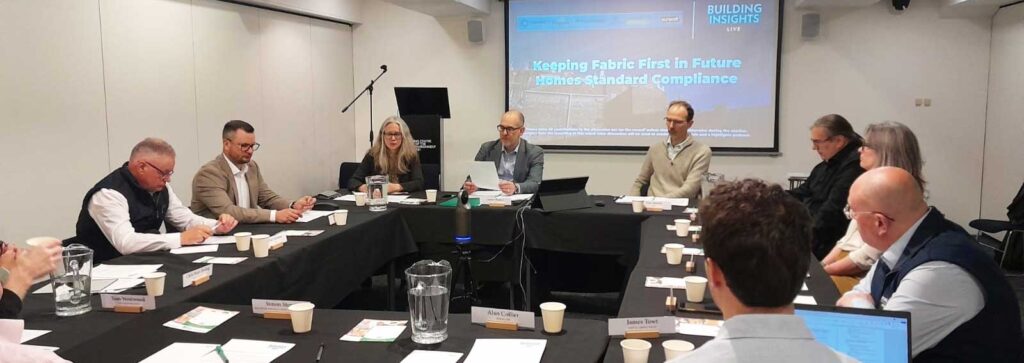
Attendees however agreed that without addressing the fabric first, there was a good chance that technologies such as heat pumps would fail to deliver the performance required, and the outcomes in terms of damaging customer trust could be catastrophic. The question is, however, not whether the industry is prepared, but whether Government is prepared to mandate higher minimum performance levels, and penalties for failing to deliver them. Jonathan Ducker of Kingspan Insulation, raised the question of how developers in England could be encouraged to go beyond the relatively low fabric standards in the FHS’ comparative ‘notional’ building target.
This was set against the backdrop of Wales and Scotland, where more ambitious fabric performance requirements are already in place.
One of the big issues in the standard, according to our group and many others, is that fixing roof-mounted PV at 40% of ground floor area as a ‘functional requirement’ stifles flexibility.
This limits options around other elements, such as heat pumps and overall specification.
A small uplift in airtightness (from 5 to 4) is not going to offset the de facto downgrading of the importance of the fabric in the face of an immovable PV target, in design equations. In addition, the Coefficient of Performance ascribed to heat pumps in HEM is all wrong, which skews the calculations.
Some of the panel suggested that the industry was still undervaluing the importance of detailing the fabric, particularly to avoid thermal bridges, in the Standard. Failing to take into account the need for calculating psi values, for example, could lead to another huge impact in terms of real-world performance for customers.
Each sponsor proposed a key question to the group. Keystone Lintels posed the issue that, while fabric first strategies do exist, they tend to focus on walls and insulation values, and here lies the
elephant in the room. Thermal bridging at openings can “quietly undermine performance,” if not focused on meticulously. The group discussed whether the crucial role of this detailing was underestimated, and how housebuilders could address it without slowing down builds.
Lintels in particular can have a major impact on thermal bridging here, which in turn impacts on compliance, said delegates. Ducker of Kingspan insulation said that the currently used SAP 10.3 was actually “fairly onerous on lintels,” as a result.
The risk of a performance gap between design and build therefore still exists, post-FHS. Strong communication links throughout the value chain are essential to try and avoid design aims being lost in the execution onsite and highlight the importance of rigorous delivery.
Alongside detailed modelling, this also involves working more closely with suppliers to identify potential impacts early in the process, helping to reduce costs later on.
Skills shortages are well known, but the Standard’s publication itself has reportedly led to more people leaving the market, as it has confirmed how high the bar will be raised. The possibility of having to install triple glazing, as well as heat pumps, is no doubt daunting for many SMEs, so the industry must pull together to show people viable strategies which will enable housebuilders to remain profitable.
In the final analysis, the whole building needs to be considered – a point emphasised by delegates at the round table.
Every specification decision has a knock-on effect across the entire building, and under the Standard there is significantly less room for error.
This means close attention to aspects such as sills, lintels, wall ties, as well as everything else.
Although the Standard is mandatory, it remains to be seen how it will play out in practice, as it doesn’t come fully into force until March 2027. To help the industry collaborate more transparently on solutions, with maximum information sharing throughout projects, the ‘Building Passports’ concept could be fundamental. Much like the Golden Thread, this approach would help move away from the past culture of limited accountability, where decisions were made without full buy-in across the supply chain and were often driven primarily by cost pressures.
Introducing a ‘single source of truth’ represents a significant shift for a sector already approaching the 1.5 million homes target with considerable scepticism. With Government policy and net zero priorities in flux, the industry must take the lead – particularly in prioritising fabric-first approaches – rather than waiting for direction from Government.
Our round table was a fantastic example of that collaboration of ideas and harnessing the sector’s experience, and we are grateful for all attendees’ insights and the support of our sponsors.

The Key Point is…
- Fabric first must remain central to the Future Homes Standard – low-carbon technologies such as heat pumps and PV cannot compensate for poor building fabric performance.
- The details matter – thermal bridging at openings, including lintels, sills and wall ties, can significantly impact a home’s overall thermal performance and compliance.
- Closing the gap between design and delivery is critical – detailed modelling, strong communication and early supplier involvement can help ensure designed performance is achieved on site.
- A whole-building approach is essential – every specification decision has a knock-on effect, leaving less room for error under the Future Homes Standard.
Credit – James Parker, Managing Editor, Housebuilder & Developer



Signature Projects

Careers
Find out why over 2,000 colleagues have decided to grow a rewarding career with the Keystone Group. Find out more
Find out why over 2,000 colleagues have decided to grow a rewarding career with the Keystone Group.

About Keystone Group
Our reputation is built on our strong focus on innovation and a dedication to delivering the best service to our customers. Find out more
Our reputation is built on our strong focus on innovation and a dedication to delivering the best service to our customers.